
I Analysed 200 Swimmers: The Most Common Swim Technique Errors

Updated: Apr 29
I Analysed 200 Swimmers: The Most Common Swim Technique Errors
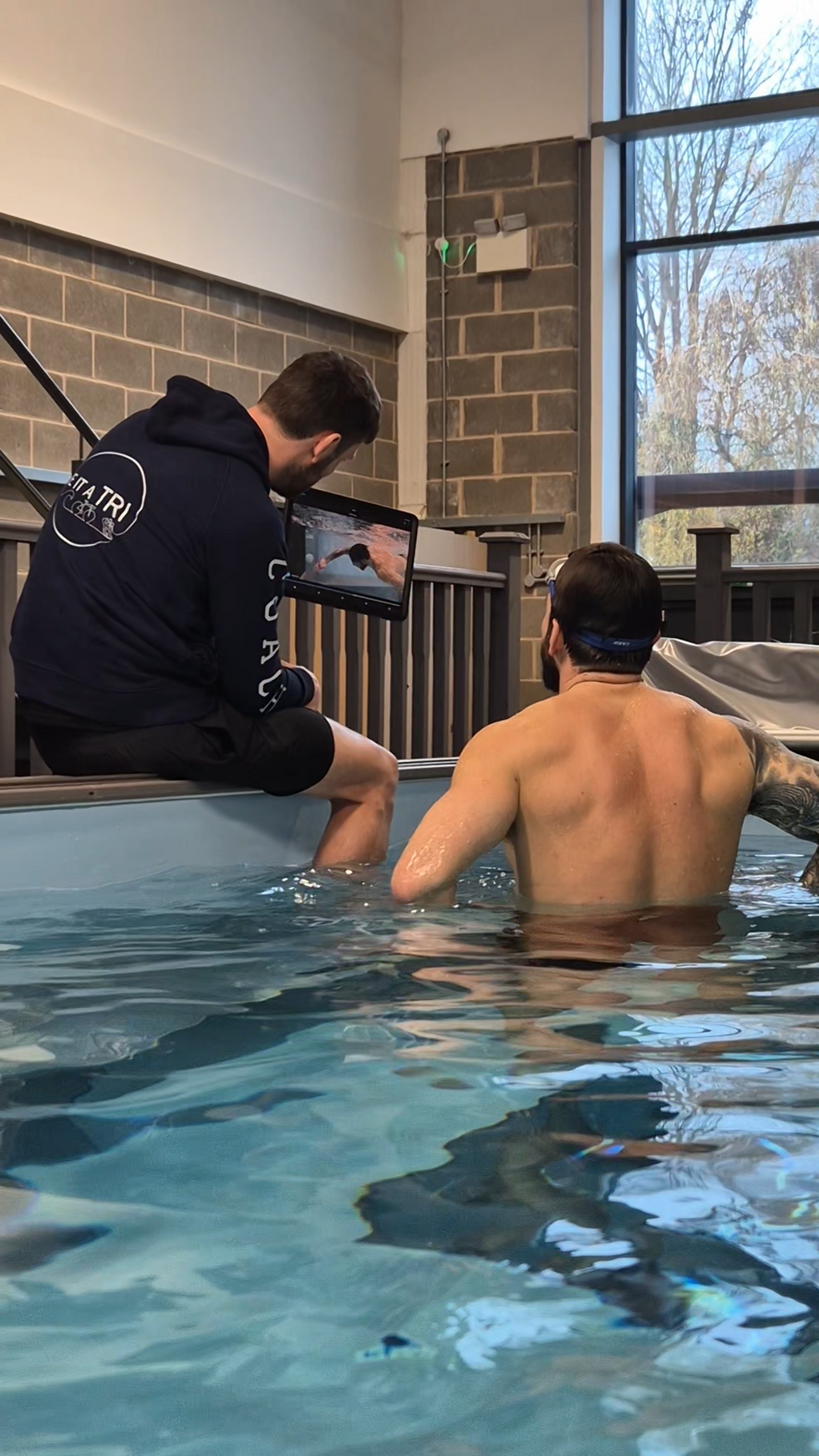
Over the past year, I’ve carried out more than 200 swim analysis sessions in London with swimmers ranging from novice triathletes to experienced IronMan athletes and competitive swimmers. Despite major differences in pace and experience, the same swim technique errors appeared again and again.
These patterns were not occasional, they were consistent across the majority of swimmers.
Rotation Is Consistently Below Optimal Levels (75–80%)
Approximately 3 out of 4 swimmers demonstrated suboptimal rotation.
Typical observations:
Rotation between 20–40 degrees
Asymmetry between breathing and non-breathing sides
Loss of rotation mid-stroke
For example:
Functional but limited rotation
Clear asymmetry linked to breathing patterns
This matters because reduced rotation leads to:
Shorter stroke length
Poor catch positioning
Increased reliance on the shoulders
Key takeaway: Rotation is one of the most common and most limiting technical factors.
Body Position Issues Appear in 85% of Swimmers (But Rarely as the Root Cause)
Around 80–85% of swimmers showed some form of body position inefficiency:
Hips sitting slightly low
Legs dropping
Front-end instability
In the majority of cases, this was not caused by head position alone. Even swimmers with good alignment still experienced body position breakdown due to:
Poor propulsion
Incorrect timing
Loss of front-end support
Key takeaway: Body position is not the primary fault; it is the result of other inefficiencies.
Entry Errors Occur in 70–80% of Swimmers
Hand entry was one of the most consistent sources of error.
Across the dataset, approximately 3 out of 4 swimmers showed at least one of the following:
Short entry
Entry crossing the centre line
Thumb-first or steep entry angle
Immediate downward “harpooning”
Examples:
Short, unstable entry patterns
Crossed or misaligned entry
These issues directly affect:
Stroke balance
Catch timing
Drag at the front of the stroke
Key takeaway: Entry is a primary determinant of stroke quality and often the starting point of inefficiency.
Catch Inefficiency Appears in 75% of Swimmers (But is usually misdiagnosed)
Approximately 70–75% of swimmers showed ineffective catch mechanics.
The underlying issue was rarely strength or effort.
Instead:
Catch initiated too deep (often 15–30cm below surface)
Lead hand dropping early
Reduced ability to hold water
Examples:
Deep catch linked to entry mechanics
Loss of front-end stability
Key takeaway: Catch problems are usually setup problems, not execution problems.
Kick Is Non-Propulsive in 80–90% of Swimmers
Across the dataset:
The majority of swimmers generated minimal propulsion from the kick
Kick was primarily used for balance and timing
Observed patterns:
Poor synchronisation with arm entry
Excessive effort with limited return
Compensatory kicking due to instability
Examples:
Efficient but low-propulsion kick
Over-reliance on kick for balance
Key takeaway: For most swimmers, the kick supports the stroke, it does not drive it.
Breathing Disrupts Stroke Mechanics in 65–75% of Swimmers
Breathing was not typically the primary issue, but it exposed underlying faults.
Approximately two-thirds of swimmers showed:
Head lift instead of rotation
Lead hand drop during breathing
Breakdown in stroke timing
Examples:
Breathing timing affecting control
Structural breakdown during breath phases
Key takeaway: Breathing highlights inefficiencies rather than creating them.
Multiple Faults Occur in Combination (Average: 3–4 Per Swimmer)
Perhaps the most important finding:
The average swimmer presented with 3–4 interacting technical faults.
Common combinations included:
Short entry → deep catch → poor propulsion
Limited rotation → wide recovery → crossover
Timing issues → instability → over kicking
Key takeaway: Swimming inefficiency is rarely caused by a single issue.

Conclusion
Across approximately 200 swimmers, the same technical patterns appeared with high consistency:
80% showed suboptimal rotation
85% showed body position inefficiencies
75% showed entry and catch-related issues
80–90% relied on the kick for balance rather than propulsion
These patterns were observed across all ability levels. Performance in the water is constrained less by fitness and more by technical efficiency.
Improvement should therefore prioritise:
Rotation
Entry mechanics
Stroke timing
These changes produce the greatest downstream impact across the stroke. You can find out more about our swim analysis in London, including the cost and availability by clicking the link.


Comments